
In This Story
As extended reality (XR) becomes part of everyday life, one undergraduate is garnering attention for ensuring immersive technology users stay safe from cyber threats. Bertram (Briar) Liu, a research assistant working with Assistant Professor Xiaokuan Zhang in George Mason University’s Department of Computer Science, earned national recognition for work on XR security at a major computing conference in October.

Liu’s first-authored paper received a Best Paper Honorable Mention Award at the Association for Computing Machinery’s (ACM) Mobile and Ad Hoc Networking and Computing (MobiHoc) first workshop on Enhancing Security, Privacy, and Trust in Extended Reality (XR) Systems. The workshop brought together leading researchers to address security challenges in immersive technologies that blend physical and digital worlds.
“It is quite an achievement for an undergraduate student!” said Zhang, emphasizing the significance of Liu’s accomplishment in a highly competitive and emerging research area.

Liu’s paper, “Hunting Insecure UI Properties in Extended Reality,” tackles critical vulnerabilities in XR environments. XR systems are susceptible to UI-based attacks due to insecure properties like spatial overlap and invisible boundaries. These vulnerabilities arise from XR’s unique characteristics of integrating digital content into the physical world, where multiple virtual elements from different sources must coexist in the same perceptual space. Liu’s paper presents a detection framework that helps developers identify potentially malicious UI elements through continuous runtime analysis.
“XR technologies are exciting, but they also introduce new ways for attackers to learn about users,” Liu explained. “Our work shows how subtle UI design flaws can confuse users and how developers can build safer interfaces.”
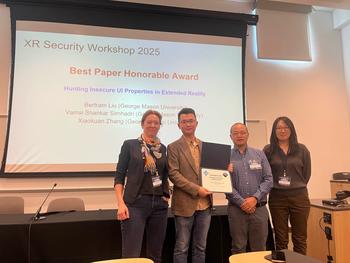
Liu’s participation in the workshop was supported by the Office of Student Creative Activities and Research’s Undergraduate Research Scholars Program and an undergraduate research grant from the Commonwealth Cyber Initiative’s Northern Virginia Node.
Reflecting on the experience, Liu said, “Presenting at a national workshop and receiving this award was surreal. It showed me that undergraduate research can make a real impact.”
This recognition underscores George Mason’s commitment to advancing cybersecurity research in emerging technologies and highlights the contributions of its students to shaping the future of secure immersive systems.